Critical Questions in Education Conference (CQiE)
San Diego, CA | Feb 9-11, 2026 | The Westgate Hotel

Deadline for proposals: December 1, 2025
The Critical Questions in Education Conference (CQiE) encourages conversations. It offers participants opportunities to present, talk, listen, and learn from one another, and to think about how they view teaching and teacher education.
2026 Conversation Themes
It’s time for your “Teacher education check-up”: The doctor wants to know . . .
- How are things going in your institution—your college or department? Are you pleased with your programs, your administration, your colleagues, your students, and/or your teaching?
- Money, enrollment, economic support for students—How are these things going for you? Is your institution ready for the demographic enrollment cliff that is looming? Has your institution suffered layoffs or program elimination/consolidations? How has your institution responded to policy changes that affect immigration and the presence of foreign students?
- If you had it to do over again, would you become a teacher—or otherwise enter the field of education? Would you encourage a young person you cared about to become a teacher? Why or why not? Why might you now love, detest, or worry about the teaching profession?
Artificial Intelligence
- Reading, writing, knowing, discovering, understanding—these have been constants in education . . . forever. How does AI change these things? How might AI weaken, replace, expand, create, or set aside traditional and important understandings of teaching and learning?
- How does AI mediate our relationships, especially between teachers and students?
- How do you use AI and what has it changed for you? What limits and policies about AI should be in place in both K-12 and higher education—for both students and faculty?
The books we read (reprise of a previous conversation theme)
- What is the best book (inside, or outside, the field of education) you have ever read—a book that changed the way you understand how you live your life, or how you see teaching, learning, and the task of education? Which of these “best books” should teacher educators, teachers, and teacher education students be reading—in or out of education classes?
When politicians have something to say . . . .
- National and state politics always influence educational policies and practices. What changes might you support given recent policy conversations and decisions, and which are reasons for worry, concern, or protest?
Present on an ongoing Academy Conversation
-
Teaching then, and teaching now: How has the narrative of teaching changed?
Present an “open” topic
- Come share conversations on conference questions while presenting on an education-related topic of your choice
Costs
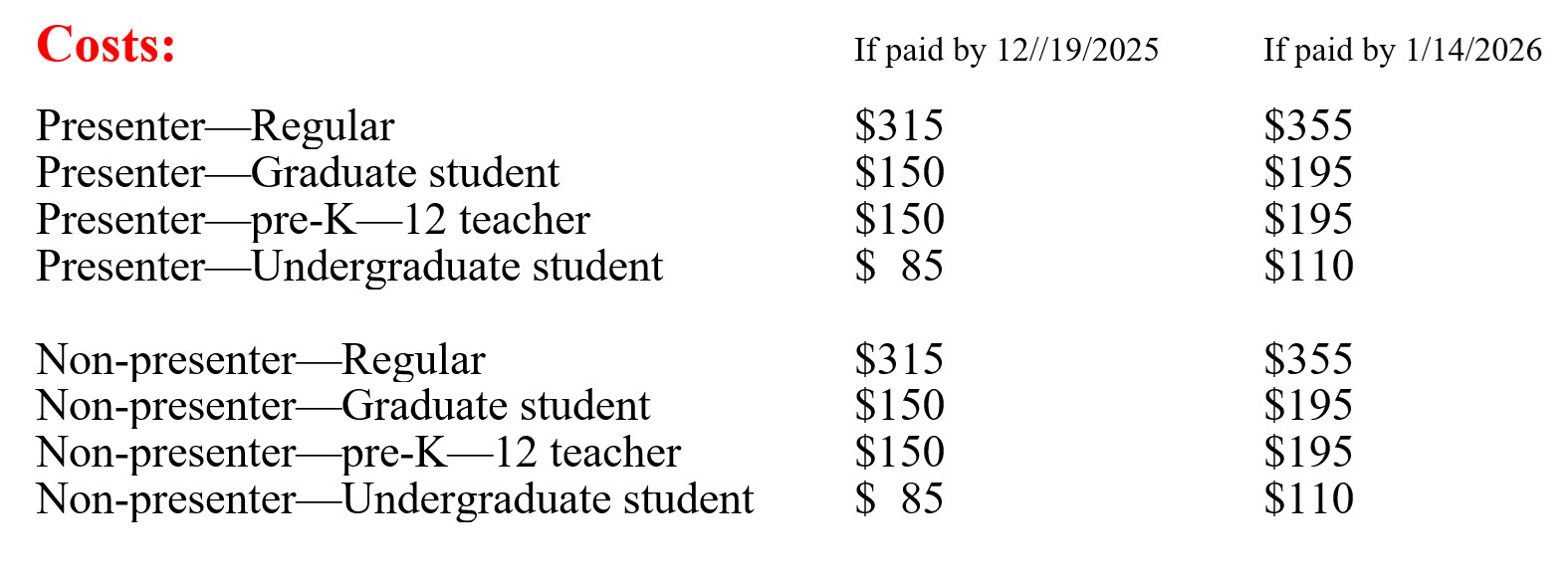
- In order to ensure their presentation spot, all presenters and co-presenters must pay the designated conference fee by January 14, 2026.
-
The organizing committee also invites non-presenters to attend the conference. Group rates for K— 12 faculty and administrators are available. Contact Steven Jones at academyedstudies@gmail.com
Submissions
The organizing committee seeks participants who offer well-considered and reflective analysis or evaluation. Original research, research review, scholarly efforts, eloquent advocacy, or reports of inspiring practice—all are welcome. The committee especially welcomes presentations that examine, or take account of, differing arguments or “sides” of a particular topic.
Presentation options are:
- Individual paper/presentation: Single (or co-authored) papers or prepared presentations. The conference committee will group submissions based on commonality of theme or approach into a 60 or 75 minute session. Presenters will share the session with others and leave time for discussion. The committee may arrange poster sessions for graduate student submissions, depending on the number of proposals received and accepted.
- Panel discussion: Three or more presenters—named, by you, in the proposal—discuss alternative solutions, interpretations, or contrasting points of view on a specified subject or theme. Panels may be either 60 or 75 minutes in length, at the discretion of the organizing committee.
- Book response: Individual papers or panels on a book, especially one related to the theme questions.
Proposal Format
Please attach your proposal to an email, as directed below. Send the cover sheet and abstract together in a single Word document. Please do not send them as separate documents. Proposals are blind, peer-reviewed.
1st page: Cover Sheet (The cover sheet will not be sent to reviewers.)
- Title of presentation
- Format of presentation: Paper/presentation, Panel, or Book response
- Information about person submitting the proposal
- Name
- Email address
- Title and institution (indicate if graduate student)
- Telephone number
- Additional presenters: Information about each co-presenter
- Additional presenters: Information about each co-presenter
- Name
- E-mail address
- Title and institution (indicate if graduate student)
- Telephone number
- Description of your presentation: Please provide a 30-word description for the printed program
2nd and 3rd pages: Abstract of presentation: No more than two double-spaced pages
- Title of the presentation, then description. Please do not reveal the identity of individual(s) submitting the proposal in the abstract. Proposals should clarify the objectives or purpose of the presentation, establish the importance of the topic, and indicate how the topic will be addressed. We do NOT need to see a list of references.
Submission Process
Send Proposals electronically to:
- Subject line: CQiE Conference proposal
- Send proposal as a single Word document attached to the email
- Deadline: December 1, 2025
Please!! Doublecheck the email address before sending—just to make sure it gets delivered to the right place!!
Peer Review Process
The Conference Committee will review each proposal. The best proposals will articulate a clear objective and purpose as well as importance of the point of view to be expressed. Proposals need to show evidence of scholarly care, clear and effective argument, and/or a basis in research. Participants are welcome to submit multiple proposals.
Notification of Acceptance
Only the person submitting the proposal may be notified of the acceptance of the proposal—and that person will need to notify all others listed on the proposal. Only those accepted participants who have paid the conference fee prior to January 14, 2026 are ensured a spot in the conference program.
Hotel Information
The conference will be held at The Westgate Hotel, in San Diego. See their website: https://www.westgatehotel.com/
The conference rate for hotel rooms is $219 per night, single/double occupancy.
Questions?
If you have any questions, please call or email Steven P. Jones, Academy Director
417-836-5982 — spjones@missouristate.edu
 AES | Academy for Educational Studies